
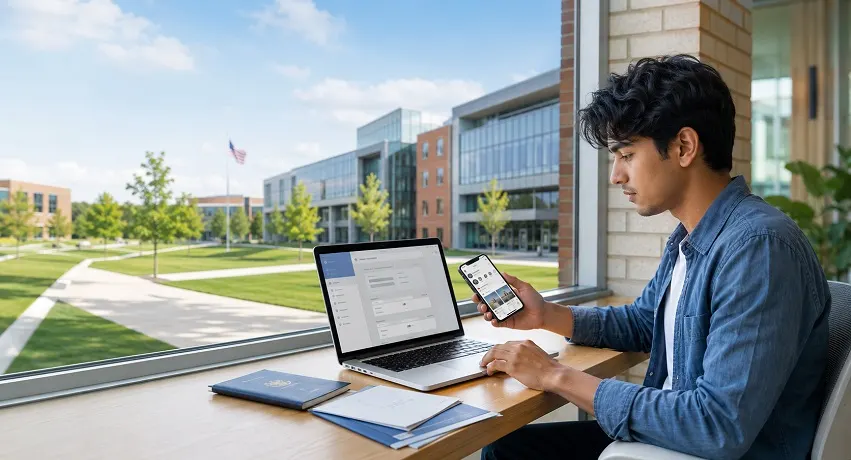
For Nepali students planning to study in USA in 2026, F-1 visa preparation now includes more than your passport, Form I-20, DS-160 and financial documents. Your online presence can also form part of the U.S. visa screening process.
Social media disclosure itself is not new: the U.S. Department of State has requested social media identifiers from most visa applicants since 2019. What changed for students from 2025 onward was the expansion of online presence review for F, M and J visa applicants. Current 2026 guidance instructs these applicants to set social media profiles to "public" or "open" so the review can be conducted.
The aim is not to create a "perfect" profile. It is to make sure your visa application is truthful, complete and consistent.
F-1 Social Media Screening in 2026 Is Part of the Wider Visa Review
The State Department confirmed in March 2026 that F, M and J applicants were already subject to online presence review. It says available information may be used to determine visa eligibility and identify national-security or public-safety concerns.
For an F-1 applicant, social media screening does not replace the normal visa requirements. You still need to show that you qualify for student status, have a genuine study purpose, can support your studies and intend to follow the conditions of the visa.
So, F1 visa social media screening 2026 should not be treated as a separate “test.” It is one part of the overall USA student visa assessment.
Your DS-160 Can Ask for Social Media Handles Used in the Last Five Years
The DS-160 social media section deserves careful attention. State Department guidance says applicants who used platforms listed on the visa application during the preceding five years must provide the associated identifiers or handles.
A social media identifier is the username, handle or name you used on the relevant platform. It is not your password. The Department’s published FAQ states that consular officers do not request social media passwords.
If you used multiple identifiers, disclose the information requested by the form accurately. An old username should not be left out simply because you no longer use it if it falls within the requested period.
If you genuinely have never used social media, the form allows "None." Do not select "None" merely because an old account is inactive.
F-1 Applicants Should Keep Social Media Profiles Public or Open
Current 2026 guidance instructs F, M and J applicants to adjust the privacy settings on all social media profiles to "public" or "open" to facilitate vetting.
This makes it important to review your privacy settings before the interview. However, there is no official instruction telling students to erase their online history or create a new “visa-friendly” personality.
Instead, check that factual information is accurate. Updating an outdated education detail or job title is reasonable if the correction is genuine. Do not invent facts, hide requested identifiers or build a false online identity to match your visa story.
What Visa Officers May Compare With Your Online Presence?
The State Department does not publish a simple list of posts that automatically cause an F-1 refusal. Its stated purpose for online presence review is broader visa eligibility, identity, security and public-safety vetting.
A practical check for students is whether the basic facts across the application make sense together. Your education and employment history should not materially contradict your DS-160. Your university and course should reflect your genuine study plan. Public information that directly conflicts with the purpose described in your application may invite questions.
More importantly, false claims, fake documents or deliberate omissions can create serious problems. The State Department warns that willful misrepresentation of a material fact or fraud may result in permanent visa refusal or denial of entry.
Social Media Does Not Replace the Core F-1 Visa Requirements
Before applying for an F-1 visa, you must be accepted by a Student and Exchange Visitor Program (SEVP)-approved school. The school enters your information in SEVIS and issues Form I-20. You then complete the DS-160, pay the required fees, schedule the visa interview and prepare your documents.
A consular officer may ask for evidence of your academic preparation, your intention to leave the United States after completing your course and how you will pay educational, living and travel costs.
For students planning to study in USA from Nepal, this is important: a clean-looking social profile cannot compensate for an unclear study plan, inconsistent documents or weak financial evidence.
There Is No Single Fixed Bank Balance for Every F-1 Applicant
There is no single universal State Department bank-balance amount that every F-1 applicant must show.
Your financial evidence should credibly support your study plan. SEVP guidance requires proof of financial resources, and immigration rules refer to documentary evidence of financial support in the amount indicated on Form I-20. A visa officer may also ask how you will pay all educational, living and travel costs.
Keep the funding story simple, traceable and realistic. If parents or close family are sponsoring you, show the relationship and their ability to fund your study. If an education loan or another documented source is involved, the evidence should match your application and interview. Avoid relying on an unexplained balance or a large recent deposit without a credible source.
The amount on your I-20 and the evidence behind your funding matter more than copying a random “safe bank balance” from the internet.
Expect an Interview and Apply in the Right Country
Under State Department rules effective from October 1, 2025, most nonimmigrant visa applicants generally require an in-person interview unless they fit limited exceptions. F-1 students should therefore normally prepare for a face-to-face interview.
Be ready to explain why you chose your university and course, how the program fits your plans, who is funding you and what you intend to do after study. Short, truthful answers are better than complicated scripts.
Another 2026 update matters for Nepali students. Since July 15, 2026, nonimmigrant visa applicants have been instructed to schedule interviews in their country of nationality or residence. For most Nepali students living in Nepal, that means applying through the U.S. Embassy in Kathmandu. Applicants using another country based on residence should be able to demonstrate that residence.
2026 F-1 Social Media Screening Checklist for Nepali Students
Before submitting your DS-160 and attending your interview:
Prepare Your USA Study Application With the Full Picture
For students who want to study abroad USA, social media screening is now one part of a complete F-1 application. The best approach is not to panic about your online history. Focus on accurate disclosure, public profile settings, a genuine study plan and financial evidence that can be explained clearly.
EducationAsia has helped 20,000+ applicants move closer to their study abroad dreams and brings 20+ years of experience in international education guidance. If you are comparing universities, preparing documents or looking for USA education consultants in Nepal, EducationAsia can help you understand university requirements and prepare for the F-1 visa process with current information.