
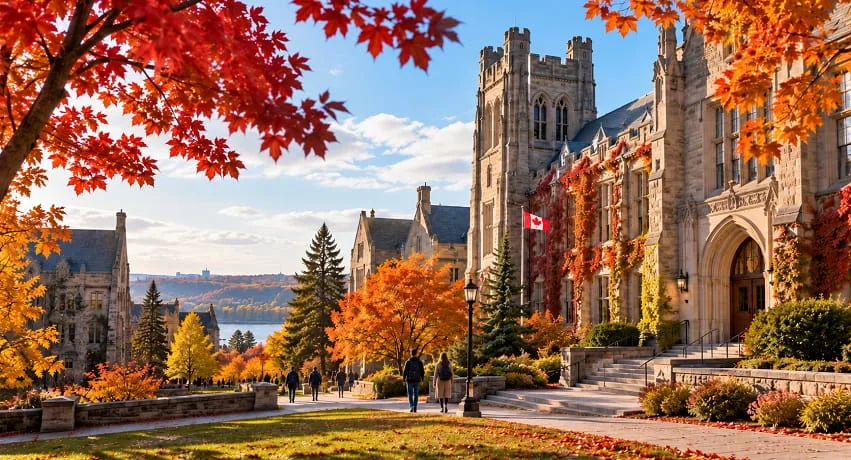
Canada has some of the world's most recognised universities. But choosing the right one is not simply about rankings. Tuition fees, course availability, admission requirements and future career plans all deserve attention.
For Nepali students planning to study in Canada in 2027, the choice has become more significant. International student regulations have changed and studying in major Canadian cities can be expensive.
The best university is not necessarily the most famous. It is the one that fits the student's academic background, financial situation and long-term goals.
This guide compares popular universities in Canada for international students and covers courses, tuition costs, scholarships and admission requirements.
Best Universities in Canada for International Students
Canada offers research-intensive universities, smaller teaching-focused institutions and specialised universities. The following institutions are worth exploring for different academic interests.
These are established universities rather than a ranking of the cheapest or easiest institutions to enter. Programmes and admission conditions vary.
Understanding the Canada Education System
The Canada education system includes universities, colleges and polytechnic institutions. They serve different academic purposes.
Universities commonly offer bachelor's, master's and doctoral degrees. Colleges often focus on diplomas, certificates and career-oriented training, although some award degrees.
A typical bachelor's degree takes three to four years. Master's programmes often take one to two years while doctoral studies usually require several years.
Students should check whether an institution is a Designated Learning Institution (DLI). This status is necessary for most international students applying for a Canadian study permit.
DLI status alone does not guarantee eligibility for a Post-Graduation Work Permit (PGWP).
Popular Courses in Canada for International Students
Choosing a course requires more than following employment trends.
Some of the widely explored courses in Canada for international students include:

Students should compare individual programme content rather than assuming similarly named courses provide identical training.
For example, a computer science degree may focus heavily on theory while another programme includes applied projects or a cooperative education component.
Professional programmes such as nursing and medicine may also involve separate licensing or placement requirements.
How Much Does It Cost to Study in Canada from Nepal?
Cost remains one of the biggest considerations when planning to study in Canada from Nepal.
According to Statistics Canada's 2025–26 figures, average annual tuition for international university students was:
These are national averages, not standard tuition charges. Certain programmes cost considerably more while others fall below the average.
For study permit applications submitted from September 1, 2026, a single student studying outside Quebec must demonstrate CAD 23,448 for first-year living expenses, separate from tuition and transportation costs.
Quebec has its own financial requirements.
Accommodation, food, transport, winter clothing and medical coverage also need consideration.
A practical budget should cover the full programme duration. Part-time employment should not be treated as the main source of tuition funding.
Scholarships for Nepali Students in Canada
Scholarships can reduce the cost of study abroad in Canada, although funding differs significantly between institutions.
Canadian universities may offer entrance scholarships, academic merit awards, departmental funding and graduate research assistantships.
The University of Toronto's Lester B. Pearson International Scholarship is one example of a highly competitive undergraduate award.
Research-based postgraduate students may find more substantial funding opportunities than students entering certain coursework-only programmes.
Academic performance, extracurricular involvement, research experience and application quality can all influence eligibility.
Some university scholarships are considered automatically during admission. Others require separate applications and earlier deadlines.
Admission Requirements for Canadian Universities
Admission requirements vary by university, course and degree level.
For undergraduate applicants from Nepal, universities generally assess Grade 12 qualifications and subject prerequisites. Postgraduate applicants usually need a recognised bachelor's degree with suitable academic results.
Common application documents include:
IELTS, TOEFL, PTE Academic or Duolingo English Test may be accepted depending on the institution. There is no single English score that guarantees entry to every Canadian university.
Applicants should check programme-specific criteria before booking an examination.
Students considering a 2027 intake should begin shortlisting universities well in advance. Deadlines vary and scholarship applications may close earlier than general admission.
Canada Study Permit Rules for 2027 Applicants
Canadian study permit requirements deserve close attention before making financial commitments.
Most applicants need a letter of acceptance from a DLI and proof of adequate finances. A provincial or territorial attestation letter (PAL/TAL) is also required for many applicants.
Since January 1, 2026, eligible master's and doctoral degree students attending public DLIs have been exempt from the PAL/TAL requirement.
This exemption does not remove other study permit requirements.
Working During Studies and After Graduation
Eligible international students can work off campus for up to 24 hours weekly during regular academic sessions. Different rules apply during scheduled breaks.
Post-graduation employment depends on PGWP eligibility. Graduating from a Canadian university does not automatically provide a work permit.
Bachelor's, master's and doctoral degree graduates from eligible institutions are exempt from the PGWP field-of-study requirement but must satisfy other applicable conditions.
Students should verify their institution, programme and current immigration rules before accepting an offer.
Choosing a University That Fits the Student
A sensible university shortlist should combine ambition with practical assessment.
Start with the intended degree and academic eligibility. Then compare total costs, scholarship availability, programme structure and location.
Students interested in cooperative education should check whether work placements are available within their specific programme.
For applicants with limited budgets, comparing universities across several provinces can uncover options that might otherwise be overlooked.
It is also worth reviewing student accommodation availability and the support provided to international students.
A recognised university with a suitable course and manageable expenses can be a stronger choice than a famous institution that creates financial difficulties.
Study in Canada with Guidance from Education Asia
Selecting universities and preparing applications can become complicated when requirements differ across institutions.
For students researching Canada education consultants or the best consultancy for Canada in Kathmandu, practical guidance should begin with an assessment of academic qualifications, budget and intended courses.
Education Asia brings 20+ years of experience and has supported 20,000+ applicants in pursuing study abroad opportunities.
Its counselling services cover university selection, course comparisons, scholarship guidance, test preparation, application documentation and student visa preparation.
Students planning to study in Canada can discuss suitable options at the Education Asia office in Bagbazar, Kathmandu or arrange an online consultation.