
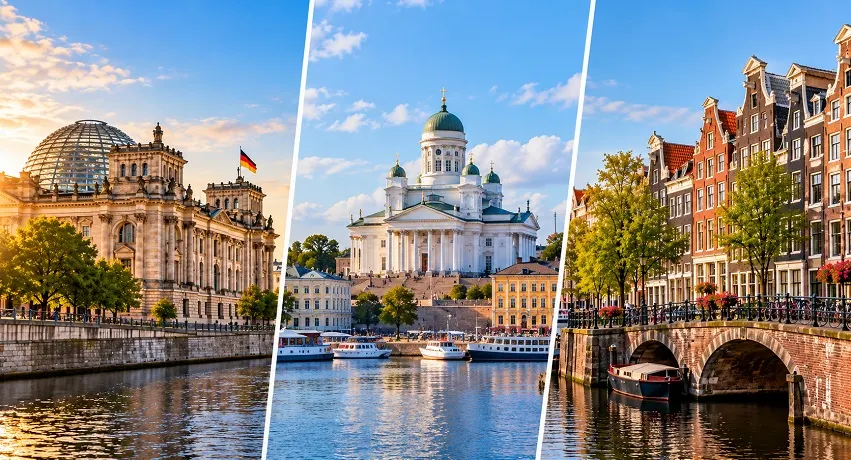
Germany offers low-cost public education. Finland attracts students with its practical learning approach. The Netherlands stands out for English-taught degrees and internationally connected universities.
But which one makes sense for a student applying from Nepal in 2027?
The answer depends on more than university rankings. Tuition fees, admission eligibility, language requirements and the ability to afford living expenses all shape the decision.
For Nepali students planning to study in Europe - Germany, Finland and the Netherlands offer different opportunities. Understanding those differences early can prevent expensive mistakes later.
Germany vs Finland vs Netherlands: A Quick Comparison for 2027
Study in Germany: Affordable Education With Strong Academic Options
Germany remains an attractive destination for international students because many public universities charge little or no tuition.
Students researching study abroad Germany opportunities should understand that affordable tuition does not automatically mean easy admission.
Understanding the Germany Education System
The Germany education system includes traditional universities, universities of applied sciences and specialist institutions.
Traditional universities generally emphasise academic theory and research. Universities of applied sciences tend to focus more on professional skills and practical learning.
Popular study areas include engineering, computer science, business, renewable energy and data science.
Students planning to study in Germany after Nepal's +2 qualification should verify whether their academic certificate meets German university entrance requirements.
Some applicants may need additional university-level study or a preparatory course called Studienkolleg before entering a bachelor's programme.
For master's applicants, recognition of the previous degree and subject compatibility are particularly relevant.
Tuition Fees and Living Expenses in Germany
At many public universities, students pay a semester contribution rather than standard tuition fees.
There are exceptions. Baden-Württemberg charges tuition for many non-EU students and some Bavarian universities also have fees for international applicants.
For student visa funding, the published 2026 German requirement is generally €11,904 per year through a blocked account or another accepted financial arrangement.
This is evidence of available living funds, not an additional university tuition charge.
Can Nepali Students Work in Germany?
Eligible non-EU students can generally work 140 full days or 280 half days annually under the standard student work allowance. An alternative 20-hour weekly arrangement is also available.
After completing an eligible German degree, graduates may obtain a residence permit for up to 18 months to seek qualified employment.
German language skills can make a substantial difference when looking for internships and jobs, even when the degree itself is taught in English.
Study in Finland: Practical Learning and Scholarship Opportunities
Students considering study in Finland often value its student-centred teaching approach and internationally recognised institutions.
Higher education in Finland consists of universities and universities of applied sciences (UAS).
Universities focus more strongly on research-based education. UAS programmes place greater emphasis on professional applications and industry-related learning.
Tuition Fees and Scholarships in Finland
For non-EU students taking English-taught bachelor's or master's courses, tuition generally ranges from €9,000 to €20,000 annually.
Some institutions offer competitive scholarships or tuition waivers.
However, students researching study abroad Finland opportunities should distinguish between a tuition scholarship and a fully funded education.
Finland does not offer a general government-funded bachelor's or master's scholarship that automatically covers tuition and living expenses for international applicants.
University scholarships usually reduce tuition rather than cover all personal expenses.
Living Costs and Student Residence Permits
Finland requires students to demonstrate sufficient funds for their living expenses.
The Finnish Immigration Service currently sets the minimum at €800 monthly or €9,600 for a full year. Official study guidance recommends budgeting approximately €900–€1,200 monthly in practice.
These expenses are separate from tuition fees.
Students holding a qualifying residence permit may work an average of 30 hours weekly across the year. Finding suitable employment without Finnish or Swedish language skills can still be difficult.
Part-time earnings should be treated as additional income rather than the foundation of a study budget.
Finland 2027 Intake Dates
For many English-taught programmes starting in autumn 2027, the national joint application period is scheduled for 7–21 January 2027.
Some institutions run separate admissions rounds with different deadlines.
Applicants should check the official Studyinfo portal and the selected university's admission requirements before preparing documents.
Study in Netherlands: English-Taught Degrees and International Exposure
The Netherlands appeals to students who prefer an internationally oriented academic environment.
Searches for study abroad Netherlands opportunities frequently focus on English-taught programmes, business education and technology-related degrees.
Universities in Netherlands for International Students
The Dutch higher education system includes research universities and universities of applied sciences.
Well-known institutions include the University of Amsterdam, Delft University of Technology, Erasmus University Rotterdam and the University of Groningen.
These examples are not a guarantee of admission or programme availability.
When selecting among universities in Netherlands for international students, applicants should examine course content, admission criteria, academic workload and graduate opportunities rather than reputation alone.
How Much Does It Cost to Study in Netherlands?
For non-EU students, average bachelor's tuition ranges from €9,000 to €20,000 per year. Master's programmes generally cost €12,000–€30,000 annually.
Students should also budget approximately €1,000–€1,500 monthly for living expenses.
Housing deserves special attention.
The Netherlands faces a serious student accommodation shortage. Securing an offer from a university does not guarantee affordable accommodation nearby.
Students intending to study in Netherlands should investigate housing availability before making financial commitments.
Netherlands Student Visa Guidance for Nepali Applicants
Reliable Netherlands student visa guidance starts with checking whether the university is an officially recognised sponsor.
For eligible full-time higher education programmes, the recognised institution normally submits the residence permit application to the Dutch Immigration and Naturalisation Service (IND).
Students must demonstrate adequate financial resources and meet the institution's requirements.
For 2026, the published university-level living-funds requirement is €1,130.77 monthly. The applicable figure for 2027 should be checked when announced.
Eligible international students may work up to 16 hours weekly or full-time during June, July and August. Employment ordinarily requires the employer to obtain a work permit.
Which European Country Is More Affordable for Nepali Students?
Germany is often the more affordable option when a student secures admission to a public university without substantial tuition fees.
Finland may become financially attractive when a meaningful tuition scholarship is awarded.
The Netherlands can require a larger overall budget, especially for master's programmes and accommodation in expensive cities.
Still, comparing fees alone is misleading.
A programme's duration, scholarship conditions, living costs and academic suitability may change the total investment significantly.
The best country is not necessarily the one with the lowest advertised tuition.
Study in Europe From Nepal: Admission Requirements for 2027
Although requirements vary by university, Nepali applicants commonly need the following:
Is IELTS Mandatory to Study in Europe?
Not always.
Certain programmes accept alternatives such as TOEFL or other approved evidence of English proficiency. Some may assess previous English-medium education.
A Medium of Instruction (MOI) certificate is not universally accepted as a replacement for an English test.
Students should confirm the exact policy with the university before assuming that IELTS can be waived.
How to Choose the Right European University for 2027?
A sensible shortlist begins with the student's academic record and available funding.
Compare at least three suitable courses across one or more destinations. Check eligibility before paying application fees.
Next, calculate total costs rather than tuition alone. Include accommodation, insurance, travel, initial settlement expenses and proof-of-funds obligations.
Application timing matters too.
German deadlines differ between institutions. Finland uses joint and separate application rounds while Dutch universities set programme-specific deadlines.
Students considering autumn 2027 entry should begin document preparation during late 2026.
Plan Your 2027 European Education With Education Asia
Choosing a destination becomes easier when academic eligibility, realistic finances and long-term plans are assessed together.
Education Asia has supported students pursuing international education since 2006, bringing two decades of study abroad counselling experience.
Students considering Germany, Finland or the Netherlands can seek guidance on course selection, university applications, document preparation and student visa requirements.
Planning to study in Europe in 2027?
FAQs
Q1. Which country is best for Nepali students in Europe?
Germany may suit applicants prioritising lower tuition. Finland offers practical and research-based education while the Netherlands provides many internationally oriented programmes. The right choice depends on academic eligibility, funding and career goals.